In today’s content economy—where disruption masquerades as depth—the web series His Dark Materials stands out as a flagship product engineered to subvert the very pillars of classical Christian worldview. It’s marketed as fantasy, packaged as adventure, but operates as a full-stack ideological counter-narrative to Biblical theology.
This isn’t mere creative liberty. It is a deliberate, strategic inversion of Christian cosmology.
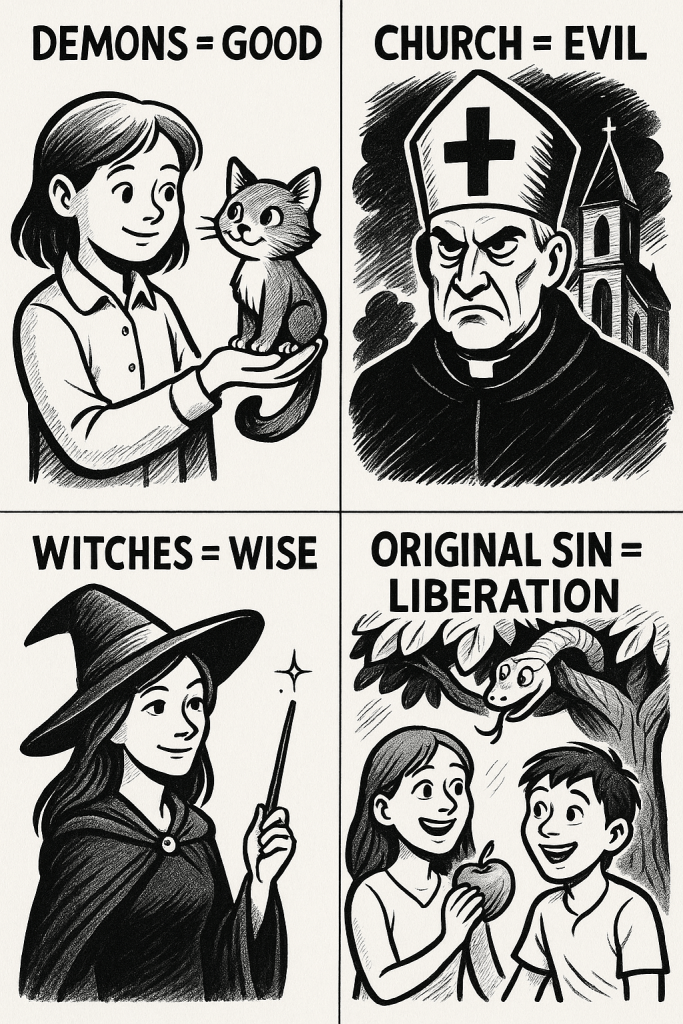
1. Daemons as “Cute Companions”: A Theological U-Turn
In Christian tradition, demons symbolize rebellion, pride, and spiritual peril.
The show, in an ironic, almost corporate rebranding effort, converts them into adorable animal-sidekicks—personal, cuddly manifestations of the human soul. Cutting a demon off a person is just like removing soul off of that person. So according to this series, human soul is nothing but a demon.
A demon as a mascot is equivalent to launching a PR campaign for moral inversion.
The message? What Scripture calls dangerous is actually delightful.
It’s disruptive storytelling, yes—but disruption isn’t inherently wisdom.
2. The Church as the Villain: An Old Trope, Recycled Again
“His Dark Materials” operationalizes the overused trope of organized religion as the omnipotent antagonist. The Magisterium is portrayed as:
authoritarian,
anti-science,
anti-human,
anti-freedom,
and chronically allergic to truth.
It’s a narrative straight out of an anti-institutional playbook: depict fathers, priests, and church leadership as conspiratorial architects of oppression. The verses from the Bible are used by the villains every now and then like crazy mindless maniacs who are on an oppressive and murderous spree.
The result? A world where authority equals cruelty, tradition equals tyranny, and faith equals ignorance.
This isn’t innovation. It’s a familiar inversion of the Judeo-Christian moral ecosystem engineered for maximum dramatic friction.
3. Witches as the Moral North Star
In the Biblical worldview, witchcraft is spiritual rebellion—dangerous precisely because it seeks power without accountability.
In the series? Witches are:
wise,
compassionate,
emotionally intelligent,
guardians of truth.
The traditional moral hierarchy is flipped:
those once warned against become the saviours.
It’s not storytelling; it’s re-architecting morality through narrative optics.
4. “Original Sin” Rebranded as a Virtue
This is the heart of the ideological disruption.
Where Christianity teaches that the Fall represents humanity’s rejection of divine guidance, the show reframes “original sin” as:
awakening,
empowerment,
self-actualization,
moral evolution.
Essentially:
What Scripture calls tragedy, the show calls progress.
The biblical warning against self-exaltation becomes a rallying cry for self-liberation. It’s the oldest rebellion repackaged as narrative inspiration.
5. The Mockery of Faithful People
Without resorting to crude language, the show unmistakably depicts individuals who adhere to Christian principles as:
irrational,
hysterical,
mentally unstable,
obsessed with control,
incapable of nuance.
This portrayal isn’t accidental; it’s strategic. It caricatures faith not as a lived moral philosophy, but as a psychological defect.
In corporate terms, it is brand damage via narrative engineering.
6. The Grand Design: A Worldview Reversal
Add it all together and the formula becomes obvious:
Demons = Good
Witches = Wise
Church = Evil
Authority Figures = Oppressors
Traditional Morality = Backward
Original Sin = Liberation
This isn’t light entertainment. It’s a deliberate philosophical provocation—a systematic dismantling of classical Christian foundations in the name of modern myth-making.
Conclusion: A Cautionary Engagement
“His Dark Materials” excels as high-production fantasy, no question.
But beneath the cinematic polish lies a mission-driven narrative: invert the sacred and sanctify the forbidden.
For viewers rooted in Christian tradition, the show isn’t just counter-cultural; it is a full-spectrum ideological challenge—artfully executed, cleverly coded, and unapologetically revisionist.
If one chooses to watch it, one should at least walk in with eyes wide open.
 The Eternal Muslim
Leave a comment