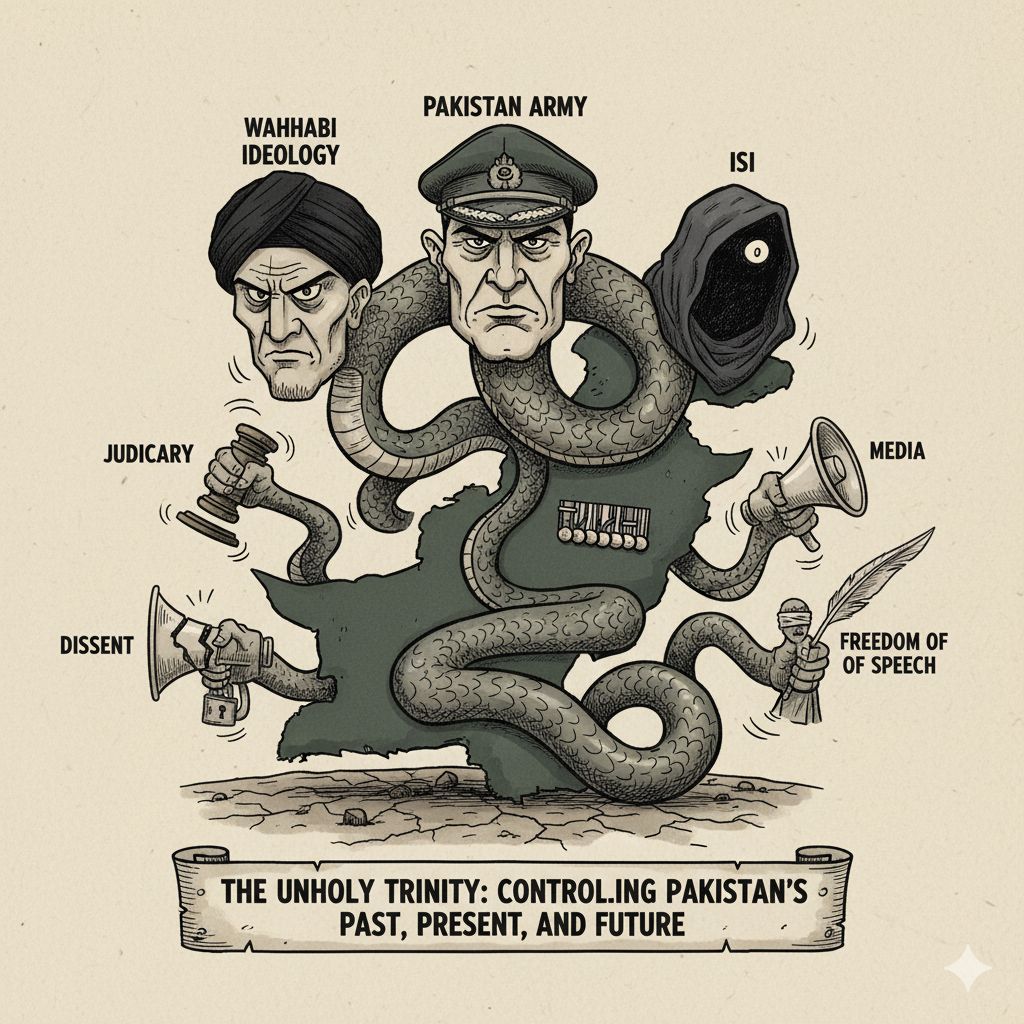
In Pakistan’s history of military overreach, the so-called 27th Constitutional Amendment represents not reform, but legalised absolutism. The amendment effectively crowns General Asim Munir as a lifelong ruler — granting him immunity, unified command of all armed forces, and the ability to override civilian and judicial oversight.
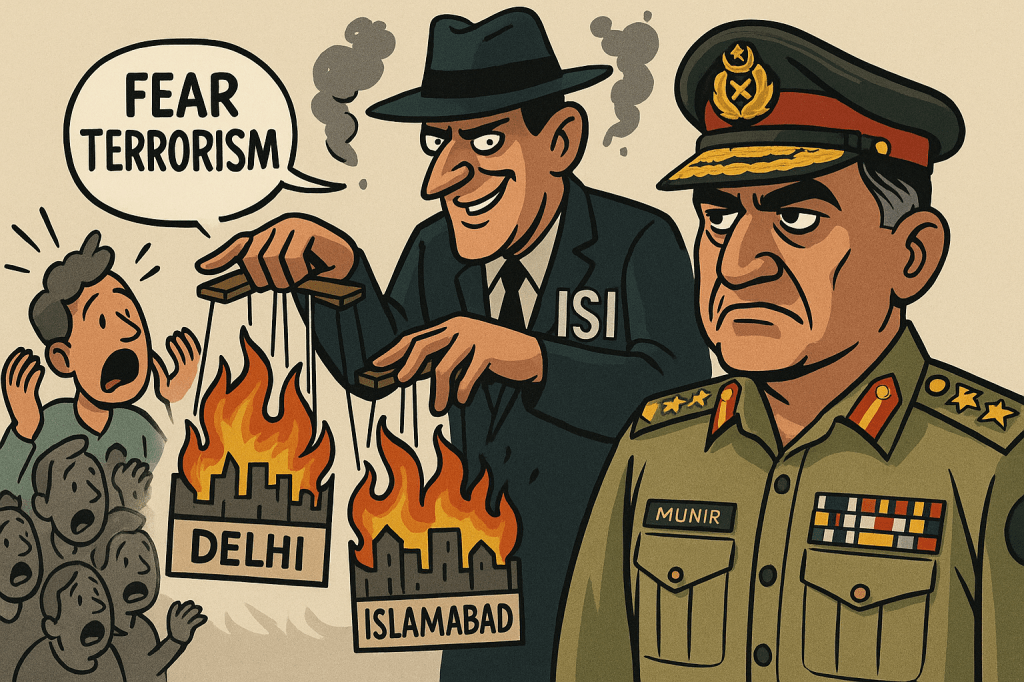
But behind this political earthquake lies a darker strategy — fear management through orchestrated terror. Whenever the public begins to question the military’s chokehold, explosions rock the nation; the smoke of terror conveniently clears the path for new authoritarian decrees.
The Constitutional Coup
Between 10–12 November 2025, Pakistan’s parliament bulldozed through the 27th Amendment with stunning speed. The opposition walked out; debate was minimal; dissent was labelled “anti-state”.
What the amendment does:
Abolishes the post of Chairman Joint Chiefs of Staff Committee and replaces it with a new Chief of Defence Forces (CDF) — automatically occupied by the Army Chief (Asim Munir).
Grants lifelong ranks, privileges, and immunity to five-star officers.
Curbs Supreme Court powers and introduces a Federal Constitutional Court, largely under executive influence.
Essentially, Pakistan’s democracy was turned into a military franchise.
Sources:
Al Jazeera – https://www.aljazeera.com/news/2025/11/11/how-would-pakistans-27th-amendment-reshape-its-military-and-courts
Jurist Commentary – https://www.jurist.org/commentary/2025/11/how-pakistans-27th-constitutional-amendment-shields-its-army-chief-from-accountability
Fear as Political Currency
Every authoritarian regime sells the same product — security in exchange for submission.
To make that sale convincing, fear must first be manufactured.
As the 27th Amendment was pushed forward, both Islamabad and Delhi witnessed sporadic terror threats and attacks. Media hysteria surged; military spokesmen spoke of “foreign hands”; the public, exhausted and terrified, silently consented to more power for the army.
It’s an old trick:
Use internal explosions to justify external aggression.
Use border skirmishes to silence domestic dissent.
When terror strikes, democracy ducks.
The ISI Playbook
The Inter-Services Intelligence (ISI) has long perfected the art of plausible deniability — using proxy groups to advance military goals while keeping its fingerprints invisible.
Each wave of terror serves a dual purpose:
1. Reinforce the army’s indispensability (“Only we can protect you”).
2. Create a political vacuum by paralysing civilian confidence.
If terror erupts near Delhi, the narrative becomes “India’s threat demands unity under the army.”
If bombs go off in Islamabad, the story turns to “Our capital is under siege — we need stronger control.”
In both cases, fear becomes legislation’s midwife.
The Wahhabi Connection
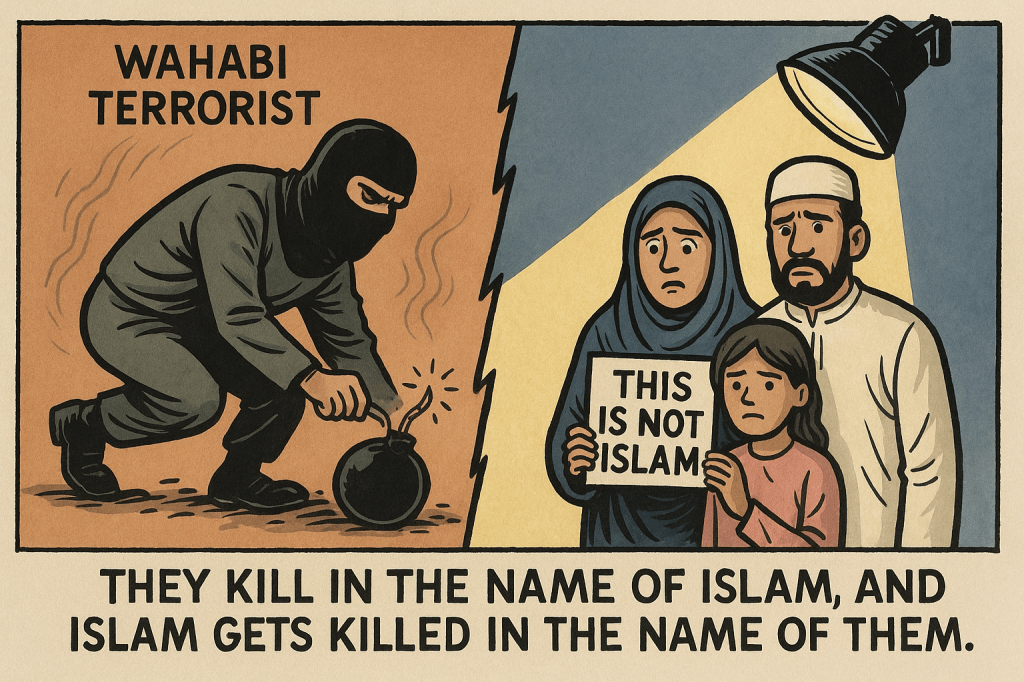
This isn’t just a military story; it’s ideological.
The Wahhabi doctrine — imported via Riyadh’s gold and it’s ideological cover and Washington’s strategic support — has infiltrated Pakistan’s barracks, seminaries, and bureaucracy. It glorifies blind obedience and demonises dissent.
By embedding Wahhabi thinking within the army and intelligence services, Pakistan’s deep state ensures that religion itself becomes an instrument of control. The soldier becomes the mujahid; the general becomes the emir.
Under this fusion of faith and force, terror is no longer chaos — it is policy.
Result: The Amendment Passes, the Republic Collapses
Once fear saturates the airwaves, people crave order at any cost.
And so, the 27th Amendment sails through Parliament while civil society sits in stunned silence.
Now, Pakistan has:
A constitution rewritten for one man.
A judiciary neutered by design.
A military command beyond reproach.
Opposition parties, TLP movements, and independent journalists find themselves cornered — vilified as “agents”, “traitors”, or “foreign-funded radicals”.
The Mirage of Security
Each bomb, each “unknown” attacker, each televised funeral pushes the nation deeper into dependency on its tormentors.
The real enemy is not across the border — it is the empire within.
An empire that thrives on Wahhabi extremism, cultivates crisis, and harvests fear.
If terror is the disease, then the Pakistani military-intelligence nexus is both the doctor and the dealer.
Ideological Identity: Wahhabism Disguised as Jihad
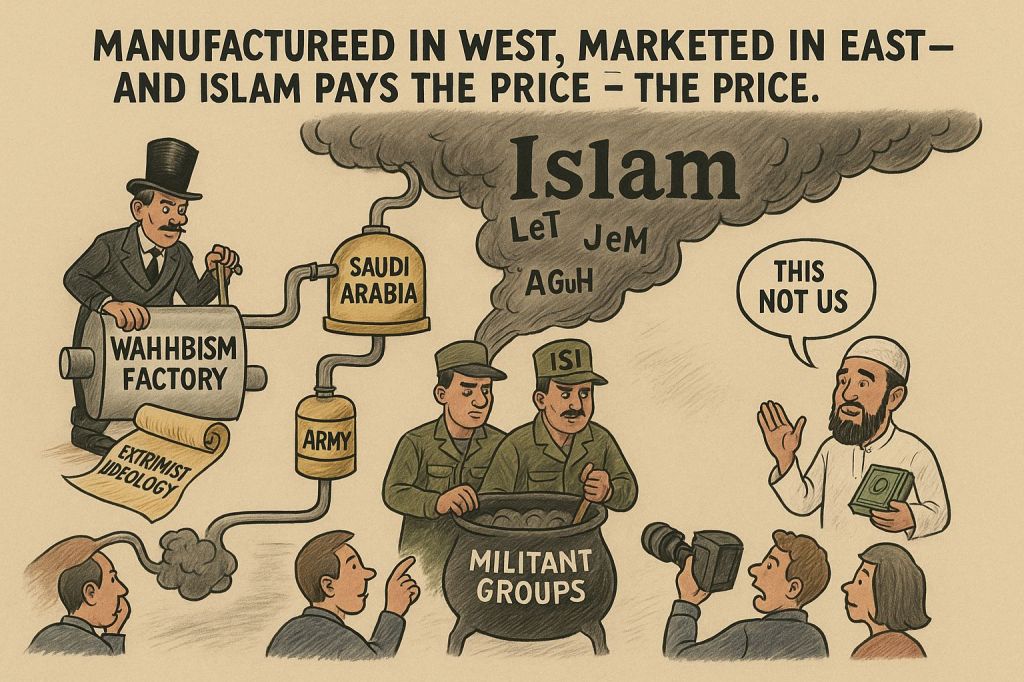
While Indian and international reports usually label JeM and AGuH simply as “Islamist” or “Pakistan-based terror outfits,” their doctrinal DNA is unmistakably Wahhabi — the same ultra-puritan ideology propagated by Saudi clerical networks and exported through Pakistani madrasas since the 1980s.
1. Jaish-e-Mohammed (JeM)
Founded by Masood Azhar, a cleric trained in Deobandi-cum-Wahhabi seminaries that blended puritan Sunni theology with militant jihadism.
Preaches takfir (excommunication of other Muslims), opposes Sufi shrines, and follows Salafi-Wahhabi literalism in doctrine.
Receives logistical and ideological backing from Pakistan’s Wahhabi-leaning establishments under ISI supervision.
Promotes the “Ghazwa-e-Hind” concept — a Wahhabi-inspired eschatological prophecy of conquering India under “pure Islam” (i.e wahabism)
2. Ansar Ghazwat-ul-Hind (AGuH)
Offshoot of Al-Qaeda in the Indian Subcontinent (AQIS).
Founded by Zakir Musa, a known Salafi-Wahhabi ideologue who broke from Hizbul Mujahideen for being “too political” and not “purely Islamic.”
Advocates strict enforcement of Shariah, rejection of nationalism, and allegiance only to the “Caliphate” — all hallmarks of Wahhabi-Salafi extremism.
Ideologically and financially linked to global Wahhabi networks in the Gulf and Pakistan.
Connecting the Dots: Delhi Blast and Wahhabi Ideology
The suspects arrested for the Delhi Red Fort blasts reportedly had connections to JeM and AGuH — two groups that owe both their funding and ideology to Wahhabi-Salafi clerical pipelines.
Thus, even if Indian agencies avoid the label in public press releases, the doctrinal affiliation is not ambiguous.
Their ideological signatures — hatred of Sufism, glorification of martyrdom, rejection of democracy, and allegiance to a global Caliphate — all point directly to Wahhabi indoctrination, not traditional Sunni or Sufi Islam.
In Simpler Words
So yes — every suspect connected to JeM or AGuH is by extension Wahhabi-influenced, because those organisations are nothing but militant arms of the Wahhabi world order exported via Saudi-Pakistani intelligence collaboration.
The media may phrase it softly — “radical Islamist,” “ultra-orthodox,” “jihadi extremist” — but let’s call it what it is: Wahhabism weaponised.
Caution and Closing Note
While direct evidence of ISI-orchestrated terror attacks to pass the 27th Amendment is not publicly confirmed, the timing, pattern, and psychological manipulation are too convenient to ignore. The burden of proof, as always, lies buried beneath layers of secrecy.
But one truth remains unambiguous:
A constitution born in fear cannot protect freedom.
Quick Reference Links (for blog embedding or citations)1. https://www.aljazeera.com/news/2025/11/11/how-would-pakistans-27th-amendment-reshape-its-military-and-courts
 The Eternal Muslim
Leave a comment